Blog
Lara Lincoln
•
2026-04-03
Coming Up for Air
It's been nearly two years since our last blog post, and we won't pretend otherwise. The silence wasn't intentional; it was the reality of a small team doing a lot of work.
For a stretch from late 2024 to early 2025, our Executive Director Elizabeth Cooper was running BERI's day-to-day operations largely on her own, managing over 30 active collaborations and laying the groundwork for an organization ready to grow. We're grateful, and a little in awe. Since then, BERI has welcomed Special Projects Manager Lara Lincoln and Program Manager Andreas Pashos. The three of us, along with our fractional bookkeeper Cierra Johnson, have been keeping busy!
The team isn't the only thing that's grown. Since launching our fiscal sponsorship program in mid-2025, we've significantly expanded our range and reach. BERI now supports more than 115 active collaborations across 15 countries, with over 20 employees and dozens of contractors embedded directly with those groups. In 2025, we exceeded $8.26 million in grants, up from $4.94 million in 2024 — a 62.7% increase year over year.
That growth reflects something larger happening in the field. Through conversations with researchers and funders, we're hearing consistent signals: as AI development accelerates toward transformative AI, the philanthropic infrastructure needed to support safety research is expected to grow with it. Funders have signaled their commitment to keeping pace. That means more projects, more researchers, and more demand for the kind of operational support BERI exists to provide.
We're preparing to meet that demand. We've launched our search for a Deputy Director, and we plan to bring on additional operations staff in the coming months, so keep an eye on this space for new job postings.
We also want to be clear about our goals as we look ahead: while AI safety is where much of our current work lives, it isn't the only place we want to grow. BERI's mission has always been broader than any single cause area, and we're actively interested in supporting projects across the full range of existential risk, spanning biosecurity, nuclear deterrence, and other emerging threats to humanity's long-term future.
Finally, we're recommitting to external communications. That means regular updates on our collaborations, our thinking, and the work happening across our network. We have a lot to share, and we're looking forward to sharing it.
Read more
Elizabeth Cooper
•
2024-03-08
BERI 2023 Annual Report
We’ve released our 2023 annual report.
This document includes both high-level and program-specific summaries of our activities in 2023 and plans for each program in 2024.
Previous annual reports have included a section containing predictions for the coming year. In order to publish our predictions in a timely manner, this year we opted to publish our predictions and goals for 2024 in a blog post.
2023 was a time of change for BERI. We grew from one to two full-time employees, brought on a record 14 new trial collaborations, and doubled our direct spending on our collaborations program. We’re excited to continue this work in 2024 while also finding additional ways to support and impact the existential risk community.
We are extremely grateful to all of our donors for continuing to make our work possible. Thank you!
Read more
Elizabeth Cooper
•
2024-03-01
2024 Collaborator Survey Results
In January 2024 we sent a survey to 70 of our collaborators, attempting to measure their opinions of BERI. The survey was based off the previous collaborator survey sent in 2022. No questions were omitted from this year’s version, but several new questions were added.
Who responded to the survey?
We sent the survey to 70 individuals, including at least one person from each of our main university collaborations and key individuals at more established trial collaborations. We biased our selection of recipients towards those we’ve helped recently (in 2023), but also included some individuals who had particularly involved relationships with BERI prior to 2023.
Like our last survey in 2022, this survey was anonymous. There were 30 responses, all of which were submitted in January and February of 2024.
For more information on BERI, please refer to our website or email contact@existence.org.
Quantitative Feedback
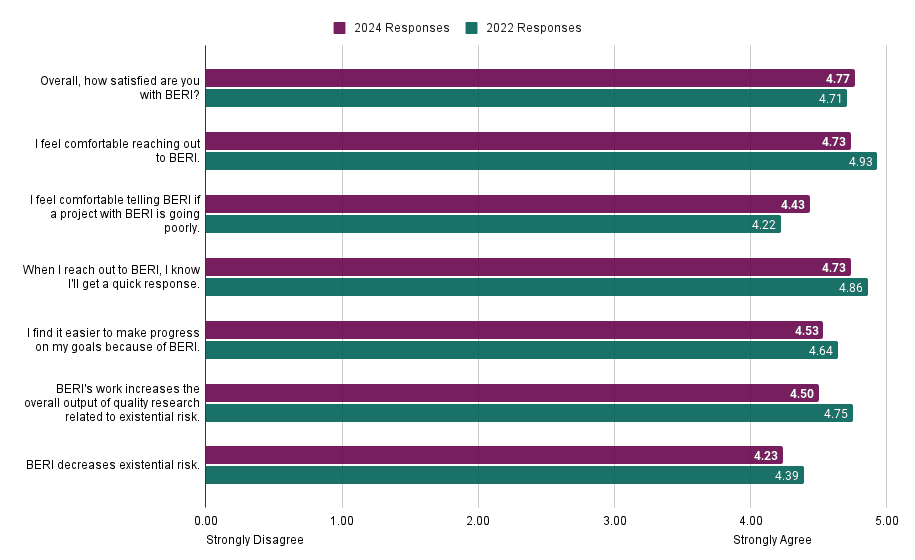
Additionally, 2024 respondents report that:1
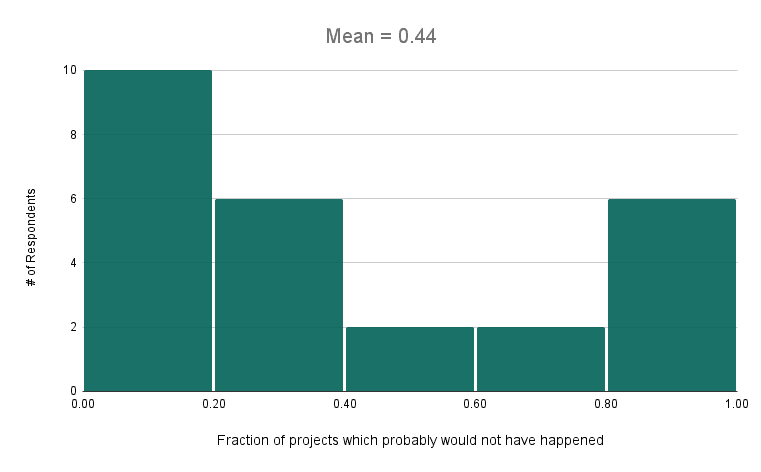
44% of projects which received BERI’s help would not have happened otherwise.
This is higher than the 35% reported in 2022
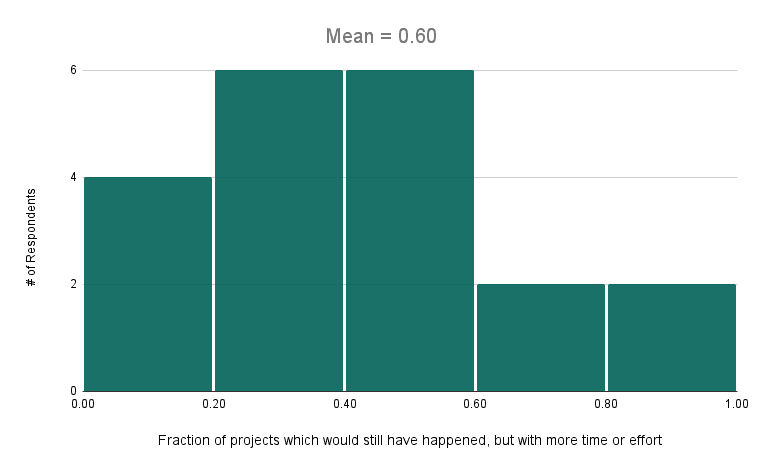
60% of projects which received BERI’s help would still have happened otherwise, but more slowly or in a way that would have taken more of their time or effort.
This is slightly higher than the 54% reported in 2022
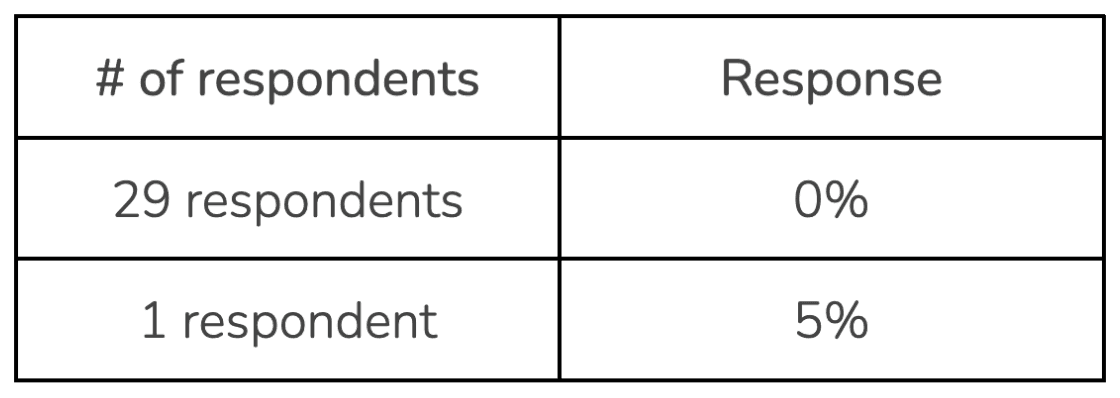
1% of projects which received BERI’s help were made slower or more difficult by BERI’s involvement.2
This is the same as was reported in 2022
Qualitative Feedback
In order to keep comments anonymous, we’ve removed sentences and censored phrases that included identifying information. We’ve also made minor grammatical corrections.
What do you like about BERI?
BERI is easy to work with and has provided very useful support in a variety of ways.
Quick and clear answers, open communication. I could trust BERI to do the right things.
In general, BERI’s quick resourcing amplifies and speeds our impact. Among qualities, my favorite is that BERI staff speak plainly and act on their words. Among resources, my favorite is resourcing minimal procedural delay - enabling in days (or hours) what would cost weeks or months to shepherd through University processes.
Makes it very easy to buy things compared to [university] purchasing
Fast and flexible way to do things university bureaucracy is bad at
Sawyer is friendly, pragmatic, communicates clearly, just overall great.
So responsive, genuine problem solvers, feels like they genuinely are invested in our group and want us to succeed
Things are easy.
They focus on asking what we need in order to carry out our research. Too many times the academic grant process and the way universities focus on research income encourages researchers to ask for as much funding as they think they can get regardless of what is needed, or alternatively we have to dramatically change the direction of our research to fit the focus of the funding scheme, which almost always results in weak research outcomes.
Very responsive. Very transparent wrt decision-making. Very positive/upbeat.
Super fast turnaround times. No bureaucratic headache.
Its mission
BERI staff extremely approachable and constructive
Really on top of everything, never have to worry about a dropped thread
What do you dislike about BERI?
I worry we build [our group] dependent on / accustomed to BERI resource support…which, should BERI lose funding, would disappear. A solution to that might be to designate as “endowment” a portion of BERI’s funding for evergreen or long-wind-down staff.
Nothing really, as a BERI-supported researcher it’s all upside
I’m not quite sure what their scope or funding situation is, or what kinds of work they want to help with.
Wish they had partner offices abroad to further expand global impact (this is probably a relatively unique issue for our group tho)
Nothing
Nothing so far.
It should be in the UK
Too small - could be bigger!
What is one thing that BERI doesn’t currently do, but that you wish we did?
I did not know of the existence of BERI until a colleague pointed me to it. Might be useful for you to also advertise your existence a bit more, so people know what options are out there (or I might have just been in a bubble)
Wild idea: a central “comms” / PR resource that could fractionally help BERI-supported orgs with communications. This would seem to make sense as we get a river of press inquiries, and the positioning of [our lab] as well as other BERI-supported orgs could be somehow clarified and coordinated by a single comms resource. When (e.g.) the BBC wants a view on LLM impacts on LAWS, comms could (1) assure consistent messaging, and (2) suggest other BERI-supported orgs’ possible interviewees.
One thought that came to mind (didn’t have it before this question) is maybe doing some training on best practices for organization management? Many of us are starting orgs for the first time and are learning on the fly. If there are best practices we can learn to scale up quickly in this area it might make all of our orgs more efficient!
Am planning a May global meeting on AI safety, perhaps could act as admin hub for that
I don’t know exactly all the things BERI does. In my case, it’s quite flexible.
Perhaps keep/share high-level documentation on different collaborations. As someone who was hired into an existing collaboration, it would have been useful to have a doc called something like ‘BERI + ‘my org name’: overview’. This might have included info on what ways BERI had supported us in the past, how much funding BERI had earmarked for the org, and what constraints there are on the use of those funds.
Fund PhDs
Appendix
Thinking about projects of yours that have received BERI help, what percentage of those projects would probably **not** have happened without BERI's involvement?
Continuing to think about projects of yours that have received BERI help, what fraction of those projects **would** still have happened without BERI's involvement, but more slowly or in a way that would have taken more of your time or effort?
Thinking about projects of yours that involved BERI in some way, what percentage of those projects were made slower or more difficult by BERI's involvement?
Notes
See the appendix section for details on these numbers. These simplified results implicitly assume that BERI works on the same number of projects with each of our collaborators, which is not the case.
Specifically, all respondents said 0% except for one respondent, who said 5%.
Read more
Elizabeth Cooper
•
2024-02-12
BERI Returns All FTX Funds
We are happy to announce that as of January 31, 2024 BERI has returned funds received from the FTX Foundation (also referred to as the FTX Future Fund) in the amount of $389,745.
BERI received the following grants from the FTX Foundation, each for a specific project:
$100,000 on April 7, 2022,
$55,000 on May 18, 2022,
$130,000 on September 22, 2022, and
$98,000 on October 18, 2022.
The returned fees equaled the $393,000 less legal fees incurred in preparing the settlement.
In discussion with the lawyers involved, FTX was open to a settlement for significantly less than the full amount donated. However, we chose to return the full amount granted to ensure that BERI does not benefit from theft or fraud in any way.
We’re excited to put this situation firmly behind us and to continue working towards our 2024 goal of further diversifying our funding base.
Read more